Jessica Rinker was my Vermont College of Fine Arts, Writing for Children and Young Adults program mentor. One class ahead of mine in the MFA program, it meant she was there for me, looking out with advice and support. She was a great mentor, and I always felt her love during the program and beyond.
Now, this year, we both have our first books coming out. Jessica’s is a picture book biography of a feminist Gloria Steinem, Gloria Takes A Stand, available March 12 from Bloomsbury Children’s Books. I am so excited to introduce Jessica here and to help celebrate her upcoming debut with a guest post about her meandering journey toward this exciting moment in her life, and how she came to write this important story.
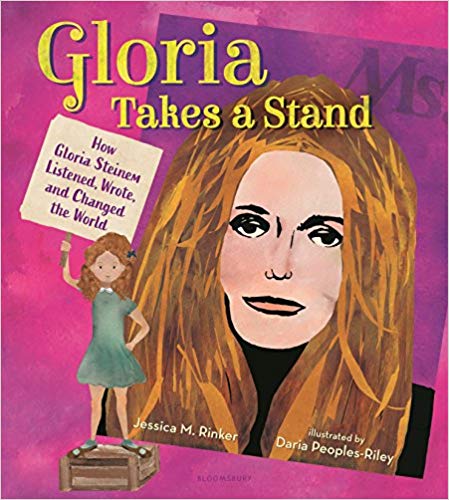
When I told my dad I’d written a children’s biography about Gloria Steinem he gave me a funny look and said, “The bra-burner?” He’s not alone in his reaction. Many people have asked how I came to write Gloria Takes a Stand, and how I was able to capture her life of activism into a story that resonates with children. There’s never a simple answer to how a book is born, or any piece of writing for that matter. My good friend Suzanne Roberts, after the success of a personal essay that she seemingly whipped up in a matter of days, said that it took “twenty years and a week” to write. And that’s the truth of it. As writers, our entire lives go into every piece we create. Even children’s books.
Gloria’s life contains multitudes. As everyone’s does. She’s nearing 85, she’s seen forty more years of life than I have and I have reinvented myself at least twice. What struck me from the beginning of my research was her passion for listening to other people’s stories. This comes across clear in her memoir My Life on the Road, but it’s evident in all her work, even early articles. In fact, an earlier title for my book was What Gloria Heard because I was so taken with the idea of paying attention to what others are saying. Seems like such a simple concept, yet we hardly do it especially in difficult times. It is the only way to help make change happen. But more often we resort to yelling, incessant posting on social media, or resign and say “things could be worse.” I resigned to that way of thinking for far too long.
In the mid-90’s, I was in college studying social welfare. A combination of psychology and sociology, this major prepared me for understanding people. Gloria was only briefly mentioned in my courses. Betty Friedan as well. And the black women who truly led this movement? Not a word. White women were mere specks and activists of color were non-existent in a curriculum about social change. Outside the classroom, I spent most my time with a very conservative, often fundamental group, FCA—Fellowship of Christian Athletes. Our FCA wasn’t just athletes, it was simply the only campus bible group that we had. I found a lot of comfort in that group, made some good friends, and enjoyed the singing more than anything else. But from the beginning, it was a struggle for me to ever feel sincere in a prayer circle or bible study. Because of the fundamental beliefs of so many of my friends, I was incredibly conflicted. I didn’t believe the nonsense they believed, and kept that to myself because these people loved me. It could be worse, right? So when these friends and Christian leaders said women activists like Gloria and Betty were angry lesbians who had essentially set out to destroy the American family, I believed them. Or maybe I should say I believed them enough. I didn’t want to rock the boat. I was terrified of causing conflict, so I just let the conflict rage inside me.
A few years later, around age 25, after I’d had two children, I wanted to go back to school and get my masters, but I wasn’t sure in what yet. Starving for an intellectual outlet and stimulation beyond nursing and diapers and church, I began looking up information about Betty Friedan. I was still hearing how horrible all those “liberal, lesbian” activists were, but now I had the fortitude to start finding out for myself. I did this in secret, researching feminists online like one might sneak around to find porn. I didn’t want my then-husband to know. I didn’t want him to see the printed chapters of The Feminine Mystique that I’d started highlighting. I didn’t want him to see the continual growing conflict in my heart, or admit I didn’t believe the same things he did because that might mean that I would have to make a choice eventually. I told myself still, things could be worse. And on the storm brewed.
I think our first real argument was over whether or not homosexuality was a sin. I’d had a cousin give birth to a baby with ambiguous genitalia. I’m oversimplifying, but babies born with this genetic condition have underdeveloped sex organs or exhibit both male and female sex organs. My cousin’s baby had the latter, and the parents had to decide on corrective surgery. Would their baby be a boy or a girl? They chose girl because the surgery was easier. I didn’t really need proof for my side of argument, but this situation certainly solidified it. For my husband it did not.
After that, I realized our lives were on two different tracks. Within a couple years, and my third baby, I told my sister that when my kids were grown, I’d leave this marriage. I wasn’t even thirty yet and I continued this duality for nearly another decade because I was afraid to make a move, afraid to hurt others. Hurting myself was easier. Then time came for me to make that choice that I’d felt stirring inside so many years before. And yet there was a huge part of me that still felt that what I wanted or believed wasn’t worthy. Besides my husband wasn’t a bad person; I could certainly do worse, why not just accept it? I was learning, but I still had that tape in my head telling me I wasn’t worthy, and I continued to press play until the tape was worn thin, and finally snapped.
Once liberated—from myself more than my marriage—I truly began to grow. Gloria’s memoir came out and I read an article about it on NPR, which then sent me to search for it the next time I was in a Barnes and Noble. There was one copy left, and it was signed. I was ecstatic. I gobbled that book up in two days, fascinated with Gloria’s childhood on the road, saddened by her years of caring for her mentally ill mother, and enlightened by her experiences that took her around the world. Through the memoir you can see how the course of her life, the simple act of living as a writer, led her to become a speaker, an activist, and eventually an icon. She became bolder with age and experience. I believe she also came to love and respect herself more—and to that I could sincerely relate. Once I was able to accept that what I wanted was okay, that I was enough, I was able to make good choices for myself. And honestly I liked myself a whole hell of a lot more.
I have been learning from women who have gone before me my entire life. My mother, my aunts, my grandmother and so on. But I learn from younger women too. I’m a perpetual observer of other people’s lives, as my education prepared me for and is my job. I have culled more information on how I do not want to live my life than perhaps more on how I do! There’s a quote, to whom I don’t know to attribute, that says: “Only a fool learns from his own mistakes. The wise man learns from the mistakes of others.” The same goes for successes. For all experiences.
I read everything Gloria wrote and what I took away from it was this: If we are truly paying attention, truly hearing other people’s stories, we will learn from them and we will understand how to change our lives or better help others. This is empowerment in its finest. The power of stories—ours and others—is where all change begins. When we feel that we have no control over the writing of our own story, we feel powerless. Children are a perfect example of this. They have no power, they often have no voice. They are abused, sold, sexualized, neglected, ignored. They are also loved, cherished and well-cared for. But even those beloved children have moments, maybe years, when they do not feel heard.
Gloria Steinem taught me how to listen better. But she also taught me how to speak. I didn’t realize when I started working on this book that I, in turn, might have the privilege to do the same for children.
People are going to keep asking me why I wrote about the “bra burner”. I will explain to them that Gloria never burned a bra, in fact no one ever did. Google it. And since the initial conversation with my dad, he’s read the book, and keeps a copy of it on his table to brag about me. He’s come around. Hopefully everyone will.
Thank you so much, Jessica, for being here, and for sharing your story with us.


 Katiaesque
Leave a comment