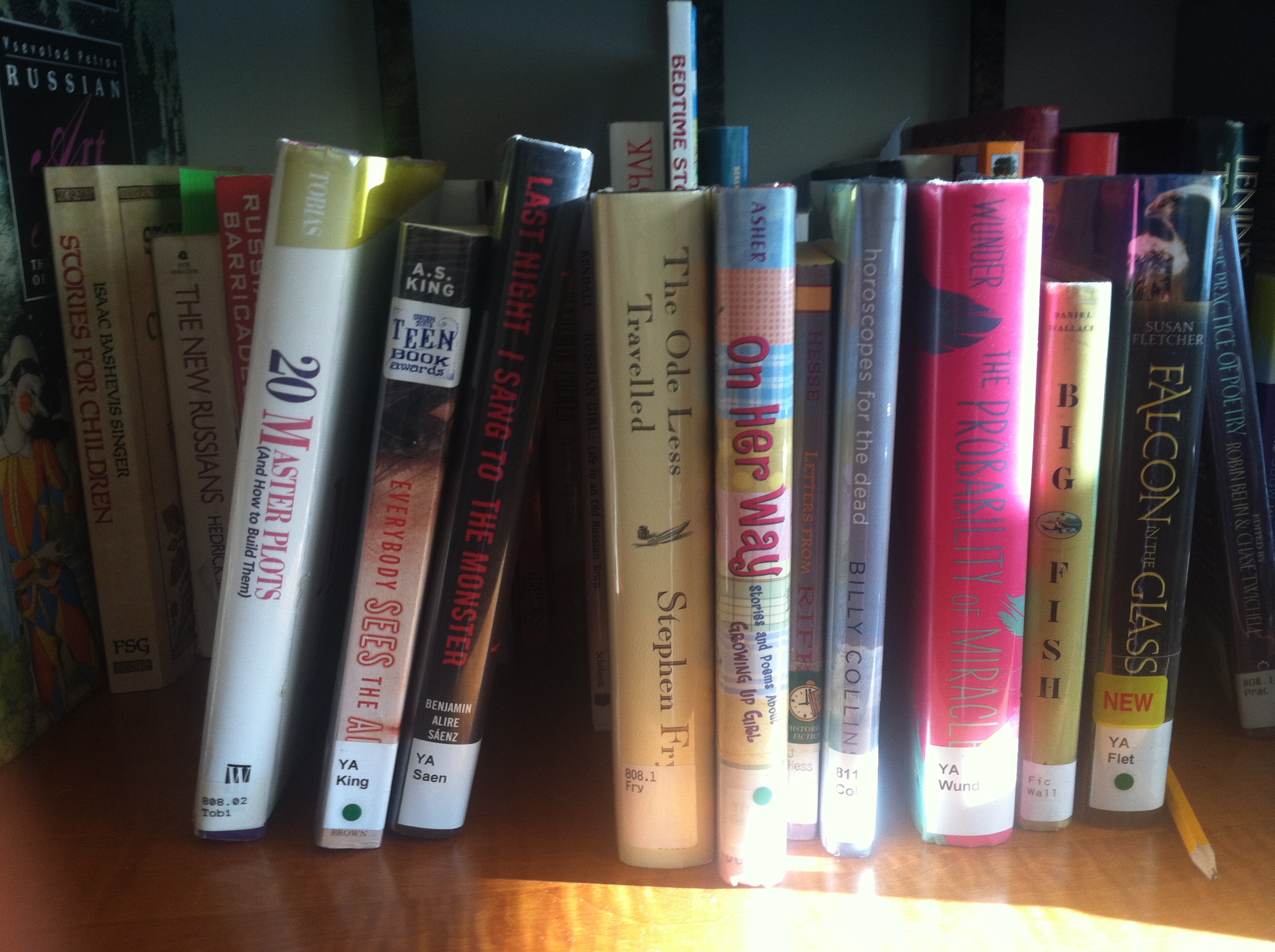
 So I am about halfway through the Writing For Children And Young Adults program now — another year to go! — and last week I wrote my last Vermont College of Fine Arts essay. The realization makes me feel surprisingly wistful. The essays, anywhere from 3 to 10 pages long, were meant to help us tackle craft topics we struggle with. The essays I wrote in my two semesters definitely helped me do that.
Here is how it worked: I would read a book or two — no more than that, usually — then re-read, taking careful notes on how the author handled a particular writing or story issue. Some of my classmates tackled examples of things that haven’t been working. I, on the other hand, stuck to the successes.
It’s been an incredibly useful tool. Some of the best writers have learned the craft that way. Jack London used to copy passages of his favorite books for practice — a literary equivalent of warm-ups or scales.
If ever you are stuck on an issue; say you struggle with middles, as a lot of writers do; or you want to explore how to make your villain more believable, or your character funnier, or more spunky, or whatever. Well, why not turn to the best teachers, authors who have already been where you want to go? Read their stories, then read them again. How did they do that? The answers are there, for everyone to see.
These are the subjects I explored and the books I used: (this is not an exhaustive list)
SEMESTER 1
— Worldbuilding (Kenneth Oppel’s Frankenstein prequels, The Dark Endeavor and Such Wicked Intent). Using imagery and strong sensory descriptions to build both the “real” and the magical worlds.
— Surprise not shock in stories with a twist (Rebecca Stead’s Liar & Spy and Elizabeth Wein’s Code Named Verity). Placing clues and planting information that lead to a satisfying surprise at the story’s end.
— When to introduce magic in a fantasy story (Rohald Dahl’s Mathilda and Jennifer Donnely’s Revolution). The interesting thing about both of these stories is that, counter to the common advice to let the reader know as soon as possible what sort of story it’s going to be, both of these books introduce the magic really late. Or do they?
— Cause and effect (Louis Sachar’s Holes). On the surface it might seem like the story is laced with coincidences. Upon a closer look it becomes obvious that nothing here happens at random, that every single event builds upon the one before. My first semester advisor Tim Wynne-Jones used to say to me, the only coincidence that should be allowed in a story is one that launches the protagonist into her adventure. Everything else must flow from the character, the narrative and the story’s world. I wrote this essay to study how Sachar makes that happen.
— Language (Kathi Appelt’s The Underneath). How to make the narrative sing on the level of word and sentence. Kathi, of course, is a master at that.
— Dystopian beginnings (Nancy Farmer’s The House of the Scorpion and Paolo Bacigalupi’s Ship Breaker). Okay, these are dystopian novels, and I chose them because they are particularly good at getting the reader into the story quickly, while having to introduce a lot of information about the rules and the world. But my discoveries about an effective beginning could apply to any book genre.
SEMESTER 2
— A perfect blend of old and new (Karen Cushman’s Catherine Called Birdy). How to keep a historical novel true to its time period, while at the same time allowing the modern young reader to relate to the story. Using language to achieve both authenticity and relevance.
— The use of the present tense/first person narration, its pitfalls and opportunities (Suzanne Collins’ The Hunger Games). Present tense/first person is such a fashion in YA. But it has to be done right, in a way that doesn’t call attention to itself, in a way that makes sense for the particular story.
— Flashbacks (A.S. King’s Please Ignore Vera Dietz). I studied the seamless way she tied them to the main narrative, without making it feel like an info dump.
— Showing not telling (Martine Leavitt’s The Book of Life by Angel). Related to the above, I examined the power of restrained exposition, especially in the beginning of Martine’s gorgeous novel in verse. Martine is not in a hurry to reveal all. She carefully teases the reader.
— Yearning or protagonist’s desire (Cori McCarthy’s The Color of Rain, Shannon Hale’s Goose Girl, Karen Hesse’s Out of the Dust). I wrote two separate essays on this, one on introducing both the external desire and the internal need of the protagonist before launching the story, and the other on expressing the character’s desire using the senses throughout the narrative.
— How to impart meaning in a short novel (Eugene Yelchin’s Breaking Stalin’s Nose and Patricia MacLachlan’s Sarah, Plain and Tall). It always impressed and mystified me, the way some books manage to tell a rich meaningful story, yet stay so slim! I decided to investigate just how they do that.
Feeling curious about any of the above topics? I would be glad to share my discoveries in the posts to come. I think I’d like to start with beginnings. Looking back, I realize, many of my essays deal with beginnings, and I can see why. In a way, this entire first year has been about learning how to begin the right way. The right start can influence the entire journey.
In the meantime, what craft issues are you curious about as a writer? What do you wish to learn how to do better? Well, whatever it is, you can! 🙂 Have you a book that just makes you swoon? (and which writer doesn’t?) Have you ever wondered, how did she do that? Well, re-read it, with a pen in hand. Many discoveries await you.


 Katiaesque
Leave a reply to writersideup Cancel reply